 By Saurav Mehra
When a waterproofing contractor inspects an Indian terrace, the quote usually proposes one of two approaches: a liquid waterproofing membrane brushed, rolled or sprayed on to form a seamless skin, or a waterproofing sheet membrane rolled out and bonded in overlapping strips. Liquid membranes, such as polyurethane and acrylic coatings, flow around pipes, corners and uneven surfaces with no joints. Sheet membranes, such as bitumen, EPDM and PVC sheets, arrive from the factory with a fixed, uniform thickness and cover large areas quickly. Both can keep water out for years, but they succeed or fail for different reasons.
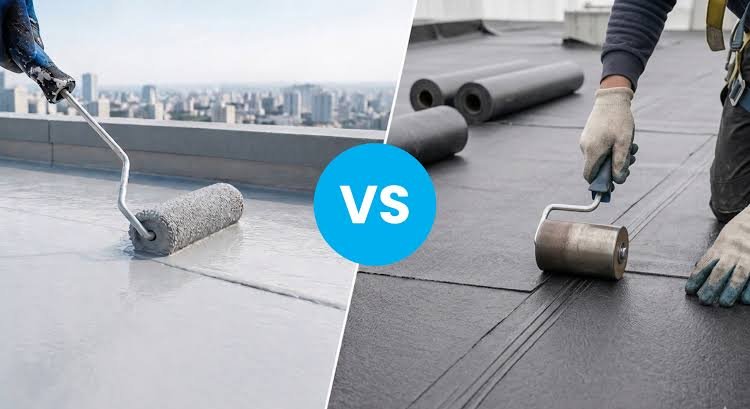
Two Ways to Build the Same Barrier
Liquid membranes are applied wet and cure into a continuous rubbery or plastic film. Common types in India include:
- Polyurethane (PU): highly flexible and durable, popular for terraces
- Acrylic elastomeric coatings: water-based, reflective and easy to recoat
- Liquid bituminous coatings: often used below ground
- Polyurea: fast-curing and very tough, mostly used in larger projects
Sheet membranes come in rolls and are bonded to the surface:
- APP or SBS modified bitumen sheets: torch-applied or self-adhesive
- EPDM rubber sheets: flexible and long-lasting
- PVC and TPO sheets: heat-welded at the seams, common in commercial roofs
Thickness: Factory-Controlled vs Site-Controlled
A sheet membrane’s thickness is fixed at the factory. If you buy a 3 mm sheet, every square metre is 3 mm.
A liquid membrane’s thickness depends entirely on how much material the applicator spreads. This is where many liquid jobs go wrong.
Suppose a specification calls for 1.5 mm dry film thickness, using a product that’s 80 percent solids. The wet coat needs to be about 1.5 ÷ 0.8 ≈ 1.9 mm thick, which means roughly 1.9 litres per square metre. For a 100 square metre terrace, that’s about 190 litres of material.
If the applicator spreads only 1 litre per square metre, the dry film ends up around 0.8 mm, roughly half the intended thickness. The roof may look fine at first but fail years early.
Two simple checks help:
- Count the containers used and compare them with the area covered.
- Ask the applicator to use a wet film gauge to measure thickness during application.
Joints, Seams and Details
Sheet membranes have seams. Bitumen sheets are typically overlapped by around 100 mm along the sides and 150 mm at the ends, then torched or pressed to seal. A badly sealed lap is one of the most common causes of leaks.
Liquid membranes have no seams. They flow around obstacles and form continuous protection, which is a big advantage on Indian terraces crowded with:
- Overhead water tank stands
- Solar panel legs and water heater frames
- Pipes, vents and drainage outlets
- Parapet walls and corners
- Dish antennas and railing posts
Cutting and fitting sheets around these features is fiddly, and every cut creates another seam. Liquid membranes handle them neatly. Many applicators combine both: sheets for large open areas and liquid membranes for details and penetrations.
Weather, Moisture and Timing
Both systems need a clean, dry, sound surface.
Liquid membranes need a rain-free window to cure, often around a day depending on the product. PU coatings are sensitive to moisture in the concrete and can bubble if applied over damp surfaces or under intense afternoon heat. Many applicators work early in the morning or late afternoon.
Torch-applied sheets also need dry surfaces, since moisture prevents proper bonding. Self-adhesive sheets need clean, primed surfaces and moderate temperatures to stick well.
For most of India, the best time for terrace waterproofing is the dry season before the monsoon, roughly February to May, when surfaces are dry and rain is unlikely.
Durability, Sunlight and Foot Traffic
Aliphatic PU topcoats resist UV and can be walked on, making them suitable for terraces used for drying clothes, yoga or gatherings. Acrylic coatings reflect heat and help keep top-floor rooms cooler, but may need recoating every few years.
Bitumen sheets resist water extremely well but need protection from sunlight, usually with tiles, screed or a reflective coating. EPDM and PVC sheets are UV-resistant and long-lasting when properly installed.
PU liquid membranes generally cost more than APP sheet systems for the same area, while acrylic coatings are usually the most economical.
Repairs and Future Changes
Indian rooftops change over the years. Families add solar panels, new water tanks, pipelines or a terrace garden.
Liquid membranes are easy to patch. A damaged area can be cleaned, primed and recoated, blending seamlessly with the existing layer.
Sheet membranes need more work to repair. Cutting through for new fixings requires patching with overlapping pieces and resealing, usually by a skilled applicator.
If you expect to modify your terrace later, a liquid system is often more practical.
Matching the System to the Area
Liquid membranes suit:
- Terraces with many pipes, stands and corners
- Balconies and small roofs
- Areas needing regular inspection or future modifications
- Roofs where a reflective, walkable finish is wanted
Sheet membranes suit:
- Large, open flat roofs with few obstacles
- Basements and foundation walls below ground
- Projects where guaranteed uniform thickness is a priority
- Areas that will be covered with screed, tiles or soil
For bathrooms and kitchens, flexible cementitious coatings are usually preferred over both, since tiles bond well to them.
Questions to Ask Your Applicator
- What product and system are you using, and is it from a single brand?
- What dry film thickness or sheet thickness is specified?
- How much material will be used for my area?
- How will pipes, corners and drains be detailed?
- How will seams or laps be sealed and tested?
- Will you do a ponding test before handover?
- What warranty do you provide, and what does it cover?
FAQs
Q1. Which is better, liquid or sheet waterproofing membrane?
A: Liquid membranes are seamless and suit complex terraces, while sheet membranes give uniform thickness for large open areas.
Q2. Why do liquid waterproofing membranes fail?
A: Often because the coating is applied too thin or over damp surfaces.
Q3. Are sheet membranes better for basements?
A: Yes, sheet membranes are commonly used on foundation and basement walls for reliable below-ground protection.
Q4. Can liquid membranes be walked on?
A: Many PU systems with UV-stable topcoats are walkable, but always check the product specification.
Q5. When is the best time to waterproof a terrace in India?
A: The dry season before the monsoon, roughly February to May, is usually ideal.
Q6. Can sheet and liquid membranes be used together?
A: Yes, many applicators use sheets for open areas and liquid membranes for details and penetrations.