 By Saurav Mehra
Winter mornings in North India often start with a familiar bathroom routine: mixing hot water from the geyser with cold water until the bucket feels just right, and how quickly that happens depends on whether you’re using a single-lever mixer tap or a two-handle tap. A single-lever mixer controls both flow and temperature with one handle, lifting to start the water and swinging left or right to make it warmer or cooler. A two-handle tap has separate hot and cold knobs, letting you adjust each supply independently. Both are widely used in Indian kitchens and bathrooms, and each has advantages depending on your plumbing, water pressure and who uses the tap.
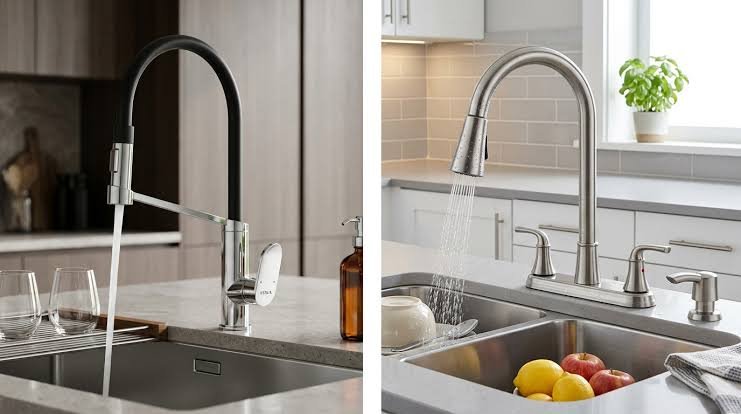
How Each Tap Controls Water
A single-lever mixer has one cartridge, usually a ceramic disc cartridge, that blends hot and cold water inside the tap. Lifting the lever increases flow, and moving it sideways changes the mix. Once you find a comfortable position, you can return to it almost instantly.
A two-handle tap has two separate valves, one for hot and one for cold. Water from both mixes in the spout or body. You turn each handle until the flow and temperature feel right.
Everyday Convenience
Single-lever mixers are quicker and simpler. In the kitchen, you can nudge the lever on or off with a wrist or elbow when your hands are covered in atta dough or oil. At the wash basin, a single motion is enough for washing hands or brushing teeth.
Two-handle taps take a little more effort, since you balance both knobs every time. However, they’re intuitive for people used to traditional taps, and the separate controls make it easy to run only cold water without accidentally drawing hot water from the geyser.
For elderly family members with arthritis or weak grip, a long single lever is usually easier than turning two knobs.
Water Pressure: The Indian Factor
This is the point most buyers miss, and it often decides which tap works better in Indian homes.
In many houses, cold water comes by gravity from an overhead tank, while hot water comes from a geyser that may be fed differently or sit at a different height. Some homes also use pressure pumps on one line but not the other. The result is unequal pressure between hot and cold supplies.
Single-lever mixers work best when hot and cold pressures are similar. When they differ widely, you may notice:
- Temperature swinging suddenly between hot and cold
- Weak flow from the mixer
- Water from the higher-pressure line pushing into the lower-pressure line, called cross-flow
Two-handle taps handle unequal pressure more comfortably because each valve is controlled separately.
If you prefer a single-lever mixer, a few steps help:
- Choose mixers designed for low-pressure systems, which many Indian brands offer.
- Ask your plumber to balance the hot and cold supply lines.
- Install non-return valves to prevent cross-flow.
- Consider a pressure pump that serves both lines, especially on top floors where overhead tank pressure is low.
Water Saved While Adjusting
Setting the temperature quickly also saves water.
Suppose a two-handle tap takes about five seconds longer to adjust each time it’s used, compared with a single lever. At a typical flow of about 8 litres per minute, those five seconds waste around 0.67 litres. If the tap is used ten times a day, that’s roughly 6.7 litres daily, or about 2,400 litres a year from one tap.
Aerators that limit flow to around 6 litres per minute at basins reduce waste further with either type.
Safety With Hot Water
Geysers can heat water to 60°C or more in winter, which is hot enough to scald quickly.
With single-lever mixers, children may push the lever fully toward hot by accident. Some mixers include a temperature limiter that restricts how far the lever moves toward hot. Thermostatic mixers go further, holding water at a set temperature even if pressure changes.
Two-handle taps let users control hot water separately, though turning only the hot handle still delivers scalding water.
For safety with either type:
- Set the geyser thermostat around 50 to 55°C.
- Teach children to start with cold water.
- Consider thermostatic mixers for homes with young children or elderly members.
Repairs and Lifespan
Both types last many years with quality ceramic cartridges.
Single-lever mixers rely on one cartridge. When it wears, the whole tap may drip or become stiff, though replacing the cartridge usually restores it. Make sure replacement cartridges are easily available from the brand.
Two-handle taps have two separate valves. If one wears out, the other side still works, and each valve can be replaced individually. Local plumbers across India are very familiar with these taps, making repairs simple.
Choosing by Location
Kitchen sink: Single-lever mixers are especially convenient, often with a tall or pull-out spout for filling large vessels.
Wash basin: Single-lever basin mixers are compact, stylish and easy to use.
Bathroom wall mixer: Indian bathrooms often need a bath spout at bucket height plus an overhead shower. Wall mixers with a diverter handle both, available in single-lever and two-handle designs. Choose based on how balanced your hot and cold pressures are.
Shower areas: Single-lever concealed mixers give a clean look, while thermostatic versions offer steady temperature.
Utility and outdoor taps: Simple cold-only taps are usually enough.
Cost
Single-lever mixers typically cost more than two-handle taps of similar quality, because of their more complex cartridge and design. Premium options with thermostatic control, concealed bodies or designer finishes cost more again.
Two-handle taps offer good value, simpler parts and easy servicing.
Which One Suits Your Home
Choose a single-lever mixer tap if:
- Your hot and cold water pressures are balanced or can be balanced
- You want quick, one-handed operation
- Elderly members find knobs difficult to turn
- You prefer a modern, streamlined look
Choose a two-handle tap if:
- Your home has unequal hot and cold pressures
- You want simple, low-cost repairs
- You often use only cold water
- You prefer a traditional design
FAQs
Q1. Which is better, a single-lever mixer or a two-handle tap?
A: Single-lever mixers are quicker and more convenient, while two-handle taps cope better with unequal water pressure.
Q2. Do single-lever mixers work with low water pressure?
A: Many do, especially models designed for low-pressure systems, but balanced hot and cold pressure gives the best results.
Q3. Why does my mixer suddenly turn hot or cold?
A: Unequal pressure between hot and cold lines often causes sudden temperature changes.
Q4. Are single-lever mixers safe for children?
A: They’re safe when fitted with a temperature limiter or thermostatic control and when the geyser temperature is moderate.
Q5. Which tap is easier to repair?
A: Two-handle taps are generally easier, since each valve can be fixed separately.
Q6. What is a wall mixer with diverter?
A: It’s a bathroom mixer that sends water either to a bucket-height spout or an overhead shower.