 By Saurav Mehra
Summer nights across most of India are spent under a whirring ceiling fan, yet tower fans, the slim, oscillating columns that stand beside the bed, are showing up in more bedrooms, especially in rented flats and rooms with low or false ceilings. A ceiling fan moves a large volume of air across the whole room for very little electricity. A tower fan directs a gentler, focused breeze at bed height, takes up little floor space and can be moved from room to room. Which one keeps you more comfortable depends on your room, your ceiling, whether you use an AC and how you like air to feel while you sleep.
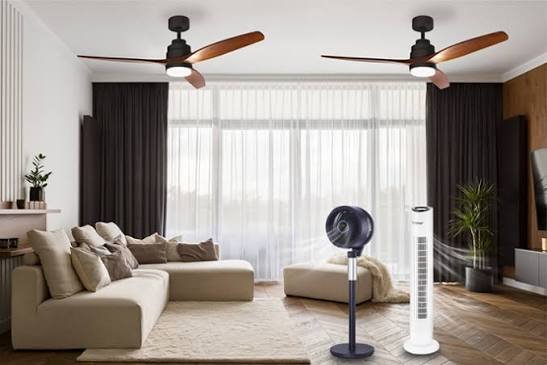
How Each Fan Moves Air
A ceiling fan has three or four wide blades spinning above the room. It pushes a column of air downward, which then spreads across the floor and circulates through the space. Ceiling fans come in two motor types:
- Induction motor fans, the traditional design, typically using around 50 to 75 watts at full speed
- BLDC fans, with brushless DC motors, typically using around 28 to 35 watts and often controlled by remote
A tower fan uses a tall cylindrical blower inside a vertical housing. Air is drawn in from the back and pushed out through a long, narrow grille in front. Most tower fans oscillate side to side and include timers, sleep modes and remote controls.
Air Delivery: The Numbers Tell the Story
Fans are compared by air delivery, measured in cubic metres per minute.
A standard 1,200 mm ceiling fan typically delivers around 210 to 240 cubic metres of air per minute. Tower fans generally deliver much less, often in the range of roughly 8 to 15 cubic metres per minute, depending on the model.
That means a ceiling fan moves many times more air than a typical tower fan. In a hot Indian bedroom, especially without an AC, that larger air movement makes a real difference to how cool you feel.
Since January 2023, BEE star labels have been mandatory for ceiling fans in India. The label shows air delivery and power use, making it easier to compare efficient models.
Electricity Use Over a Summer
Here’s how running costs compare for a bedroom fan used about 10 hours a night for a full year:
- BLDC ceiling fan at 30 W: about 110 units, roughly ₹770 at ₹7 per unit
- Induction ceiling fan at 70 W: about 255 units, roughly ₹1,790
- Tower fan at 50 W: about 183 units, roughly ₹1,280
A BLDC ceiling fan is the most economical, delivering the most air for the least power. It also runs longer on a home inverter during power cuts, which is a big advantage in areas with frequent outages.
Sleep Comfort and Noise
Ceiling fans create an even breeze across the whole bed and room. Some people find full-speed airflow too strong or drying, especially for the eyes and throat. Lower speeds or a slight shift in bed position usually solve this.
Tower fans give a softer, directed breeze. Oscillation spreads air gently across the bed, and sleep modes gradually reduce speed through the night. They’re well suited to light sleepers who prefer a mild airflow.
On noise, BLDC ceiling fans are very quiet. Older induction ceiling fans may hum or click. Tower fans produce a steady whooshing sound that some people find soothing, while cheaper models can be noisier at high speed.
Room Size, Ceiling Height and Placement
Common guidance for ceiling fan size:
- 900 mm sweep: small rooms up to about 75 sq ft
- 1,200 mm sweep: standard bedrooms of about 75 to 150 sq ft
- 1,400 mm sweep: larger rooms of about 150 to 225 sq ft
Fan blades should ideally sit about 2.4 to 2.7 metres above the floor. In many Indian flats with ceilings around 10 ft, a short downrod works well.
Tower fans work best where ceiling fans aren’t practical:
- Rooms with low ceilings, lofts and attic bedrooms
- False ceilings with ducts or lighting where a fan can’t be mounted
- Rooms with bunk beds, where a ceiling fan may be too close to the upper bunk
Place a tower fan a little away from the wall so it can draw air freely, and angle it toward the bed.
Using a Fan With an AC
Many families run a fan with the AC in summer. A ceiling fan on low speed spreads cool air evenly, letting you set the AC a degree or two higher while staying comfortable, which saves electricity.
A tower fan can also help in rooms where the AC blows mainly in one direction, pushing cool air toward the bed. Its focused breeze makes it particularly useful in long or L-shaped bedrooms.
Safety and Cleaning
Ceiling fans stay out of reach of children, but they need secure installation, a sturdy hook and proper balancing. Avoid them in rooms where tall furniture or bunk beds bring heads close to the blades.
Tower fans have enclosed blowers with narrow grilles, which keep small fingers safe. Choose models with a wide, stable base so they don’t tip over.
Cleaning differs too:
- Ceiling fans: wipe the blades every few weeks, especially in dusty cities, since dust buildup reduces efficiency.
- Tower fans: dust collects inside the blower, which is harder to reach. Use a vacuum or air blower on the grilles regularly and follow the manufacturer’s cleaning guidance.
Rented Homes and Portability
In rented flats, a ceiling fan may already be installed, but if a room lacks one, landlords may not allow new ceiling fixtures. A tower fan needs no installation and moves with you.
Tower fans also double as a spot cooler for a study desk or workspace during the day, then move to the bedroom at night.
Which Fan for Your Bedroom
Choose a ceiling fan if:
- You want the strongest airflow for hot nights
- You want the lowest electricity cost, especially with a BLDC model
- Your room has a standard ceiling height
- You rely on an inverter during power cuts
Choose a tower fan if:
- Your ceiling is low or can’t take a fan
- You prefer a gentle, directed breeze
- You need a portable fan for a rented room
- You want extra airflow alongside an AC or ceiling fan
Many bedrooms work best with both: a BLDC ceiling fan for overall airflow and a tower fan for a targeted breeze on the hottest nights.
FAQs
Q1. Which is better for bedrooms, a ceiling fan or tower fan?
A: A ceiling fan moves far more air at lower cost, while a tower fan suits low ceilings and gentle, portable airflow.
Q2. Do tower fans use less electricity than ceiling fans?
A: Not usually; a BLDC ceiling fan generally uses less power than a tower fan.
Q3. What size ceiling fan is best for a bedroom?
A: A 1,200 mm ceiling fan suits most standard bedrooms of about 75 to 150 sq ft.
Q4. Are tower fans safe for children?
A: Yes, their enclosed blowers and narrow grilles make them safe, as long as the base is stable.
Q5. Can I use a tower fan with an AC?
A: Yes, it helps spread cool air toward the bed and can let you set the AC slightly higher.
Q6. Why choose a BLDC ceiling fan?
A: BLDC fans use about half the power of induction fans and run longer on inverter backup.