 By Subhash Kumar
 You know that feeling when you finally sit down after a ten-hour workday, and your shoulders are somewhere near your ears, your jaw is tight from a hundred unspoken frustrations, and your mind is still replaying that one awkward exchange from the 4 PM meeting? Most of us just call this “being tired.” But your body has actually been holding onto every bit of tension from the day, quite literally, in your muscles, your breath, and the way you’ve been unconsciously bracing yourself since morning.
This is exactly where somatic yoga earns its place, and it’s genuinely different from the yoga you might already be doing. Instead of chasing a perfect pose or a deep stretch, somatic yoga asks you to simply feel what’s happening inside your body and let that awareness itself do the releasing. For Indian professionals juggling long commutes, back-to-back calls, and screens that don’t switch off until well past dinner, these five poses offer a genuinely accessible way to actually come down from the day, rather than just collapsing onto the couch still fully wired.
What Makes Somatic Yoga Different From Your Usual Practice
Before getting into the poses themselves, it helps to understand what’s actually happening here. Traditional yoga often focuses on achieving a specific shape or alignment, which is wonderful for strength and flexibility. Somatic yoga flips that entirely. It prioritises sensation over form, asking you to notice how a movement feels from the inside rather than how it looks from the outside.
This matters because chronic workplace stress genuinely gets stored in the body as habitual muscular bracing, tight hips from sitting hunched over a laptop all day, clenched shoulders from unconscious tension during difficult calls, a shallow breath pattern that’s been running on autopilot since your first meeting. Somatic movement works from the body upward to signal safety to your nervous system, rather than trying to think your way out of stress, which is exactly why it can feel so different, and so much more immediately relieving, than simply telling yourself to calm down.
1. Cat-Cow With Full Spinal Awareness
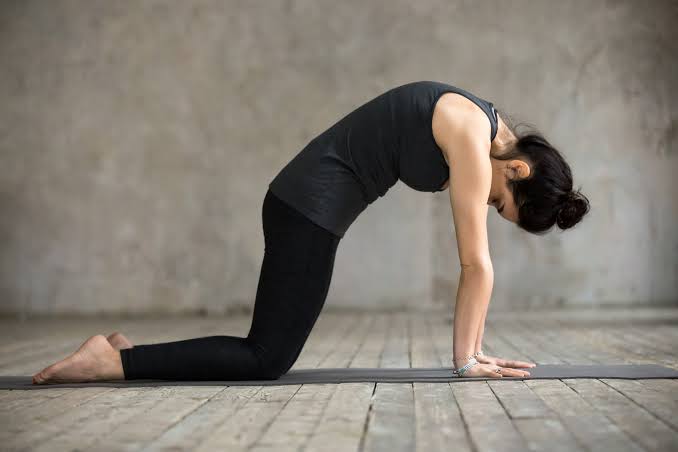
This might look like a pose you already know, but somatic Cat-Cow asks you to slow down considerably and actually feel the wave move through your spine rather than mechanically shifting between two shapes.
Come onto your hands and knees, wrists under shoulders, knees under hips. As you inhale, gently arch your back, letting your belly soften toward the floor and your gaze lift slightly. As you exhale, round your spine, tucking your chin and drawing your navel up toward your spine. The key difference here is pace, move slower than feels natural, and pay attention to which parts of your spine move easily and which parts feel stiff or resistant. This gentle undulation genuinely helps release the lower back and the psoas muscle, an area that quietly absorbs a huge amount of stress from long hours of sitting and unconscious tension.
2. Child’s Pose With Extended, Unhurried Breathing
Child’s Pose is a classic for a reason, and in a somatic practice, the goal isn’t just to stretch your hips and back, it’s to genuinely let your breath deepen and slow down while you’re there.
From a kneeling position, spread your knees comfortably wide, sink your hips back toward your heels, and extend your arms forward, resting your forehead on the mat. Rather than holding this for a fixed count, simply stay until your breath naturally slows and deepens on its own. This pose gently stretches areas where the day’s tension tends to accumulate, hips, lower back, shoulders, while the position itself, with your forehead resting down, genuinely encourages the kind of slow, deep breathing that shifts your nervous system from its stressed, alert state into something considerably calmer.
3. Legs Up the Wall for an Instant Reset
If you’ve spent your entire day on your feet or hunched at a desk, this pose is genuinely one of the fastest ways to signal to your body that the day’s demands are over.
Sit sideways next to a wall, then swing your legs up as you lie back, so your legs rest vertically against the wall while your back stays on the floor. Let your arms rest open beside you, palms facing up. Elevating your legs above your heart improves circulation, sending blood and oxygen back toward your core and brain, which genuinely helps with the heaviness and inflammation that builds up after a long day spent sitting or standing. As you breathe, picture each inhale bringing in something fresh, and each exhale carrying out whatever tension you’ve collected since morning.
4. Gentle Shaking to Release Stuck Adrenaline
This one might feel unusual the first time you try it, but it’s rooted in something animals do instinctively after a stressful encounter, they physically shake to discharge built-up adrenaline, and humans genuinely benefit from the same release.
Stand with soft, slightly bent knees. Begin gently shaking your hands, then let that shake travel up through your arms, and eventually let your whole body join in, a loose, easy shake rather than anything forced or vigorous. If lying down feels more comfortable after a genuinely exhausting day, you can do this on your back instead, lifting your legs and gently kicking or shaking them, one at a time or together. This movement genuinely helps discharge the sympathetic nervous system’s lingering activation, the fight-or-flight residue that’s been quietly running in the background through every stressful email and rushed deadline of your day.
5. Seated Breath Awareness With Self-Soothing Touch
This final practice combines two things: deliberately slow diaphragmatic breathing, and a simple self-soothing technique that genuinely helps ground you after a day spent mentally scattered across a dozen different demands.
Sit comfortably, cross-legged on the floor or in a chair with your feet grounded. Place one hand on your belly and one on your chest. Breathe in slowly through your nose, feeling your belly expand under your hand rather than your chest rising, and exhale slowly, feeling your belly draw back in. After a few rounds of this, try giving yourself a gentle hug around your shoulders, and slowly tap alternating sides, left shoulder, right shoulder, in a steady rhythm. This bilateral tapping, similar to techniques used in certain trauma-focused therapies, genuinely helps calm an overactive nervous system and brings your attention fully into your body rather than still replaying the day’s stress in your head.
Making This Realistic for Your Actual Evening
You don’t need an hour, a yoga studio, or even a mat to genuinely benefit from these five poses. Even spending two minutes on each, roughly ten minutes total, done consistently after work rather than sporadically on weekends, creates a genuinely noticeable shift in how you transition from work mode into your evening.
If ten minutes still feels like too much some days, pick just one pose, Legs Up the Wall or the gentle shaking practice tend to give the fastest, most noticeable relief, and build from there. The point isn’t perfection or a rigid daily ritual, it’s simply giving your body a genuine chance to unwind rather than carrying the day’s tension straight into your sleep, your dinner table, and tomorrow morning’s fresh set of stresses.
Frequently Asked Questions
Q1. Do I need to be flexible or experienced with yoga to try somatic yoga poses?
No, genuinely not. Somatic yoga specifically prioritises how a movement feels over achieving any particular shape or depth, so these poses work well even for complete beginners or people who’ve never done yoga before.
Q2. I sometimes feel emotional or even tear up during these poses. Is that normal?
Yes, this is a genuinely common experience, particularly with hip-opening or spine-focused movements, since these areas often hold accumulated stress and emotional tension. There’s nothing wrong with this response, it’s simply your nervous system releasing what it’s been holding onto.
Q3. How soon after work should I do these poses for the best effect?
There’s no strict rule, but doing them shortly after you get home, before diving into dinner or scrolling your phone, tends to work best since it creates a clear transition point between your workday and your evening rather than letting the stress carry forward unaddressed.
Q4. Can I do these poses if I have a pre-existing back or hip injury?
It’s worth being cautious and adapting as needed, using cushions for support, reducing range of motion, or skipping poses that feel uncomfortable rather than pushing through pain. If you have a diagnosed injury or chronic condition, checking with a doctor or a qualified yoga therapist before starting is a sensible precaution.