 By Saurav Mehra
 Buying a car in India is an emotional decision, but it is also one of the biggest safety decisions a family makes. We compare mileage, price, boot space, sunroof, touchscreen, resale value, EMI and colour. But when the same car carries your parents, children, spouse or friends on highways, city flyovers, village roads and monsoon traffic, one question becomes more important than everything else: how safe is this car in a crash?
Earlier, many Indian buyers depended only on brand reputation or salesman claims like “body strong hai” or “six airbags hain.” But safety is not only about heavy doors or more airbags. A truly safer car needs strong structure, proper crash protection, child safety support, seat belt reminders, electronic stability control and good performance in scientific tests. This is where Bharat NCAP becomes important.
Bharat NCAP gives Indian car buyers a clearer way to understand crash safety through star ratings. Instead of guessing, buyers can look at tested results and compare cars more confidently. It does not replace careful driving, seat belts or traffic rules, but it helps consumers choose vehicles that offer better protection when accidents happen.
What Is Bharat NCAP?
Bharat NCAP stands for Bharat New Car Assessment Programme. It is India’s own car safety rating programme designed to assess how well a vehicle protects occupants during crash tests and how many important safety technologies it offers.
In simple words, Bharat NCAP tests eligible cars under standard conditions and gives them star ratings. A higher star rating generally indicates better crash protection and stronger safety performance.
This programme is especially useful for Indian buyers because it focuses on cars sold in the Indian market. It helps customers understand safety beyond showroom claims and brochure language.
Why Bharat NCAP Was Needed in India
India has one of the largest car markets in the world. More families are buying cars, more highways are being built, and long-distance road travel has increased. At the same time, road accidents remain a serious concern.
For years, many Indian buyers looked at safety only after an accident or when buying expensive cars. Budget and mid-range cars were often judged mainly by mileage and features. Bharat NCAP helps shift the conversation from only “kitna deti hai” to “kitna bachati hai.”
It encourages manufacturers to improve body structure, airbags, child-seat support, seat belt systems and safety assist features. It also gives buyers a simple star-based comparison tool.
Which Vehicles Are Covered Under Bharat NCAP?
Bharat NCAP is mainly applicable to passenger vehicles in the M1 category with gross vehicle weight up to 3500 kg. In practical language, this includes most regular passenger cars, hatchbacks, sedans, compact SUVs and SUVs sold for personal use.
The rating is meant for right-hand-drive vehicles sold in India. This is important because Indian cars may differ from international versions in structure, safety equipment and variant features.
Not every car on sale automatically has a Bharat NCAP rating. Manufacturers may submit vehicles for testing, and the government can also recommend testing in specific cases.
What Do the Stars Mean?
Bharat NCAP gives star ratings to show how well a car performs in safety assessment. Ratings usually range from 1 star to 5 stars.
A 5-star rating means the car has performed very well in crash protection and meets the required safety criteria. A lower rating means weaker performance compared to higher-rated cars.
But buyers should understand one important point: stars are not decoration. They are based on testing, scoring and safety features. A car with more stars is generally a safer choice, but you should still check details such as adult protection score, child protection score and safety equipment.
Adult Occupant Protection
Adult Occupant Protection, or AOP, checks how well the car protects adult passengers in a crash. The test uses crash dummies to measure injury risk to body areas like head, neck, chest, knees and legs.
This assessment looks at the vehicle structure, airbags, seat belts, dashboard impact, footwell movement and other injury-related factors. A car should not only have airbags; its body shell must also manage crash energy properly.
For Indian families, this matters because front-seat adults are often the most exposed in serious crashes. A strong AOP score indicates better protection for driver and front passenger.
Child Occupant Protection
Child Occupant Protection, or COP, checks how safe the car is for children sitting in proper child restraint systems. This is very important but often ignored in India.
Many parents still hold children in their lap or allow them to stand between front seats. This is extremely unsafe. In a crash, even a loving parent cannot hold a child against sudden force.
Bharat NCAP child safety assessment looks at child dummy performance, child seat installation, ISOFIX support and vehicle-based child safety features. A good child protection score is important for families with babies and young children.
Safety Assist Technologies
Safety Assist Technologies are features that help reduce accident risk or improve protection. These may include electronic stability control, seat belt reminders, pedestrian protection and side head protection, depending on the rating requirements.
Electronic Stability Control is especially useful because it can help the driver maintain control during sudden swerves, slippery roads or emergency manoeuvres. In India, where roads may have potholes, sand, rainwater, animals, sudden braking and unexpected traffic movement, such features are valuable.
Safety assist systems do not make careless driving safe, but they add an extra layer of protection.
What Crash Tests Are Done?
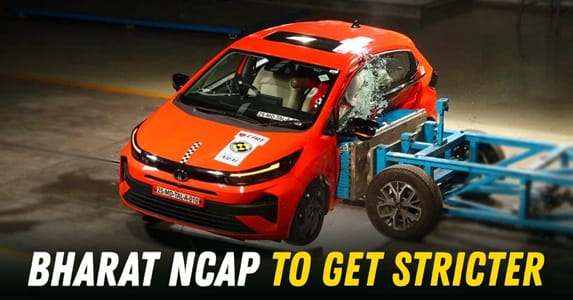
Bharat NCAP uses standard laboratory crash tests to evaluate cars. These include frontal impact, side impact and pole side impact tests as per the protocol.
The frontal impact test simulates a crash where the front of the car hits a barrier. This helps assess how well the structure protects occupants during common serious crashes.
The side impact test checks protection when another vehicle hits the car from the side. Side crashes can be dangerous because there is less space between the passenger and the impact area.
The pole side impact test is important for checking side head and body protection in a severe narrow-object crash, such as hitting a pole or tree.
Why a Strong Body Structure Matters
Many people think airbags alone make a car safe. This is not true. Airbags work best when the car’s structure remains stable and seat belts hold passengers properly.
If the body structure collapses badly, the cabin can deform, doors may jam, footwell area may move, and injury risk can rise. A strong structure absorbs crash energy while keeping the passenger compartment safer.
So, when checking a Bharat NCAP result, do not look only at airbags. Look at the overall rating and protection performance.
Does More Airbags Always Mean More Safety?
More airbags are useful, especially side and curtain airbags. But airbags are only one part of safety.
A car with six airbags but weak structure may not protect as well as a car with strong structure, good seat belts, proper airbag deployment and stable crash performance. Safety is a complete system.
Also, airbags work properly only when occupants wear seat belts. Without seat belts, airbags can be less effective or even risky in some situations.
Bharat NCAP vs Global NCAP
Global NCAP is an international safety assessment programme that tested many Indian cars earlier and helped increase safety awareness among buyers. Bharat NCAP is India’s own assessment programme for the Indian market.
Both aim to inform consumers about vehicle safety, but Bharat NCAP is designed within India’s regulatory and testing framework. It gives Indian buyers an official domestic reference point for cars sold here.
For buyers, the practical benefit is simple: more accessible safety information and more pressure on carmakers to improve safety.
How to Read a Bharat NCAP Result
Do not only see “5 stars” and stop there. Check both Adult Occupant Protection and Child Occupant Protection ratings. A car may perform differently in adult and child safety.
Also check the tested variant. Sometimes the rating applies to a specific variant or variants with certain safety equipment. If the base model lacks important features available in the tested model, you should be careful.
Look for safety features such as airbags, ABS, ESC, ISOFIX, seat belt reminders, three-point seat belts, rear defogger, reverse camera, tyre pressure monitoring and ADAS features where available.
Does Bharat NCAP Rating Apply to All Variants?
This is an important buying question. A car model may have many variants: base, mid, top, automatic, manual, petrol, diesel, CNG or EV. Safety equipment can differ across variants.
If the rating applies to all variants, it gives better confidence. But if certain features are missing in lower variants, the real-world safety package may differ.
Before booking, ask the dealer clearly which safety features are available in your chosen variant. Do not assume the top-model rating automatically means the base model has the same equipment.
Why Seat Belts Still Matter
Even the safest 5-star car cannot protect properly if passengers do not wear seat belts. Front and rear seat belts are essential. In India, many rear passengers still avoid seat belts, thinking the back seat is safe. This is a dangerous habit.
During a crash, an unbelted rear passenger can be thrown forward and injure themselves and front occupants. Children must use proper child seats according to age, height and weight.
Bharat NCAP helps you choose a safer car, but daily safety depends on correct usage.
Should You Buy Only 5-Star Cars?
A 5-star car is a strong choice, but buying a car also depends on budget, usage, service, comfort, fuel type and features. However, safety should not be pushed to the last position.
If two cars fit your budget and one has a better Bharat NCAP rating, the safer car deserves serious preference. For family use, highway travel and daily commuting, better safety can be more valuable than cosmetic features.
A sunroof, big screen or alloy wheels may look attractive, but crash protection can save lives.
Common Mistakes Buyers Make
Many buyers choose a car only because it feels heavy. Door-thud sound does not prove crash safety. Some choose only top features and ignore safety ratings. Some assume all SUVs are safer than hatchbacks. Size can help in some crashes, but design and structure matter more.
Another mistake is buying the base variant without checking airbags, ESC, ISOFIX and seat belt features. A car’s safety value depends on the actual variant you drive home.
Practical Checklist Before Buying a Car
Check the Bharat NCAP rating. Compare Adult and Child Occupant Protection scores. Verify the tested variant. Check safety features in your exact variant. Prefer cars with strong structure, six airbags where possible, ESC, ISOFIX, rear seat belt reminders and three-point belts.
Take a test drive, but do not let touchscreen, music system or sunroof distract you from safety. Ask direct questions at the dealership and verify details from official sources.
FAQs
Q1. What does Bharat NCAP rating mean?
Bharat NCAP rating shows how well a car performs in crash safety tests and safety feature assessment. Higher stars generally indicate better occupant protection and stronger safety performance.
Q2. Is a 5-star Bharat NCAP car completely safe?
No car is completely safe in every accident. A 5-star rating means strong performance under tested conditions, but safe driving, seat belts, child seats, speed control and road behaviour are still essential.
Q3. Does Bharat NCAP rating apply to all variants of a car?
Not always automatically. Buyers should check which variant was tested and whether the same safety features are available in the variant they plan to buy.
Q4. What is more important: airbags or Bharat NCAP rating?
Both matter, but the overall Bharat NCAP rating gives a broader safety picture. Airbags are important, but body structure, seat belts, child safety, ESC and crash performance also matter.